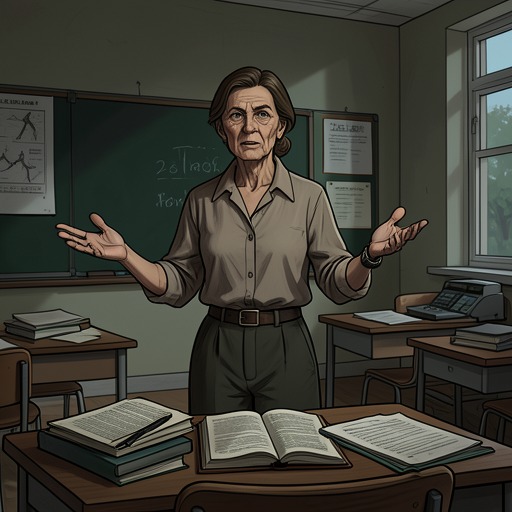
T. S. Garp and Helen Holm’s marriage
The World According to GarpT. S. Garp and Helen Holm’s marriage develops through tenderness, infidelity, shared catastrophe, and long-lasting grief. Its decisive significance lies not in a simple reconciliation or a conventional happy ending, but in the way care persists after trust is damaged and, finally, after Garp’s death: Helen spends the rest of her life keeping his work and memory from being separated from the family they made.
Beginnings of Strain
Helen’s growing closeness to Michael Milton begins within an apparently legitimate intellectual relationship. She reads his papers and, later, his stories and poems; she understands their conversations as a student-teacher exchange centered on his work. As Michael grows bolder and more attached, Helen continues to regard that connection as innocent, even while the boundary between professional attention and personal intimacy becomes less secure.
The marriage’s strain registers in Helen’s behavior at home. She smokes more and watches Garp anxiously. When she makes love to him, she feels guilty because she is acting not from desire but from a wish to reassure him that nothing is wrong. Her effort to protect the marriage through reassurance therefore reveals how far their intimacy has already been unsettled.
Discovery and Rupture
After Garp discovers Helen’s affair, she apologizes and insists that she loves him and never intended to hurt him. She asks how he found out and whether another woman was involved, but Garp refuses to look at her, concentrating instead on drying his toes. His deliberate silence turns an ordinary task into the scene’s measure of their estrangement: Helen speaks directly, while Garp withholds even the acknowledgment of her words.
The rupture also enters family life. When the children shout that Garp is still underwater, Helen panics and imagines that he has deliberately staged his drowning in front of them as a way to punish her, leaving her to explain his actions. Her interpretation is fearful and mistaken, but it shows how the marital conflict has altered the meaning she assigns to his behavior. Their children are not outside the crisis; they are present within its charged domestic atmosphere.
Recovery and Mutual Care
The family later leaves the house and driveway associated with the unwanted familiarity of their old life and goes to Jenny’s hospital by the ocean. Helen’s resignation is not attributed expressly to Michael; the move offers both her and Garp a way to get away from the home and its painful associations. At the hospital, Helen spends much of her convalescence in Duncan’s room, reading to him. She speaks little, while Jenny is better able than Helen to deal with Garp during this period.
Helen’s care for Duncan is part of a broader effort to help the family heal. Having never had a mother, and having had little opportunity to experience Jenny in that role, Helen accepts the hospitalization and hopes Jenny can nurse Garp while she nurses Duncan. The arrangement makes care reciprocal rather than heroic: Helen tends to her son, Jenny supports Garp, and the family seeks distance from the setting in which its injuries and conflicts had accumulated.
The surviving account also records Helen’s wish for another child. After Garp responds with an apology and embraces her, the family’s future is framed through tenderness rather than any claim that the past has been erased. In the aftermath of the accident, Garp is gentle with Helen and Duncan for a year, speaking softly and avoiding impatience. Jenny observes that the three of them need a year to nurse one another. That mutual recovery gives the marriage a form of renewed closeness grounded in daily patience, though the account does not present healing as a return to uncomplicated life.
Work, Loss, and Lasting Attachment
After a period in which Garp becomes absorbed again in writing and wrestling, Helen recognizes that she has remained inactive too long. She agrees to teach at Steering School so she can use her mind and develop her own ideas. Her decision marks a renewed independent life alongside the marriage: Garp’s concentration draws her emotionally toward him, but it also makes her aware that she needs work and purpose of her own.
Helen’s marriage ends with Garp’s death, but her attachment does not. As he lies unable to move anything but his eyes, Garp tries to reassure her through a silent message: life continues after him, and memory remains. Helen is trying to smile back. The moment makes their final exchange one of attempted consolation, with the surviving spouse receiving what the dying husband can no longer say aloud.
Helen lives for many years afterward, known for most of her life as Helen Garp. She has lovers but never remarries. In the Steering mansion, which she rarely leaves, she surrounds herself with evidence of Garp’s life: his books, Duncan’s photographs of him, and his wrestling trophies. These objects make memory part of the household’s daily setting and ensure that later partners encounter Garp not as a closed chapter but as a continuing presence in Helen’s life.
Preservation and Significance
Helen also becomes the guardian of Garp’s written remains. She protects his letters, most of his journals and jottings, and the unfinished manuscript of My Father’s Illusions. Biographers wait for her death in the hope of gaining access to what remains of Garp, but she outlives many of them and resists their claim on his private materials.
Her answer to would-be biographers is, “Read the work. Forget the life.” The maxim expresses a deliberate boundary: Helen preserves the writing while refusing to let curiosity about the writer’s private history take precedence. In the marriage’s final, extended phase, fidelity becomes stewardship. Although Helen has lovers and does not live as Garp’s wife in the ordinary sense, she remains devoted to protecting the work, objects, and memories through which their shared life continues to matter.